

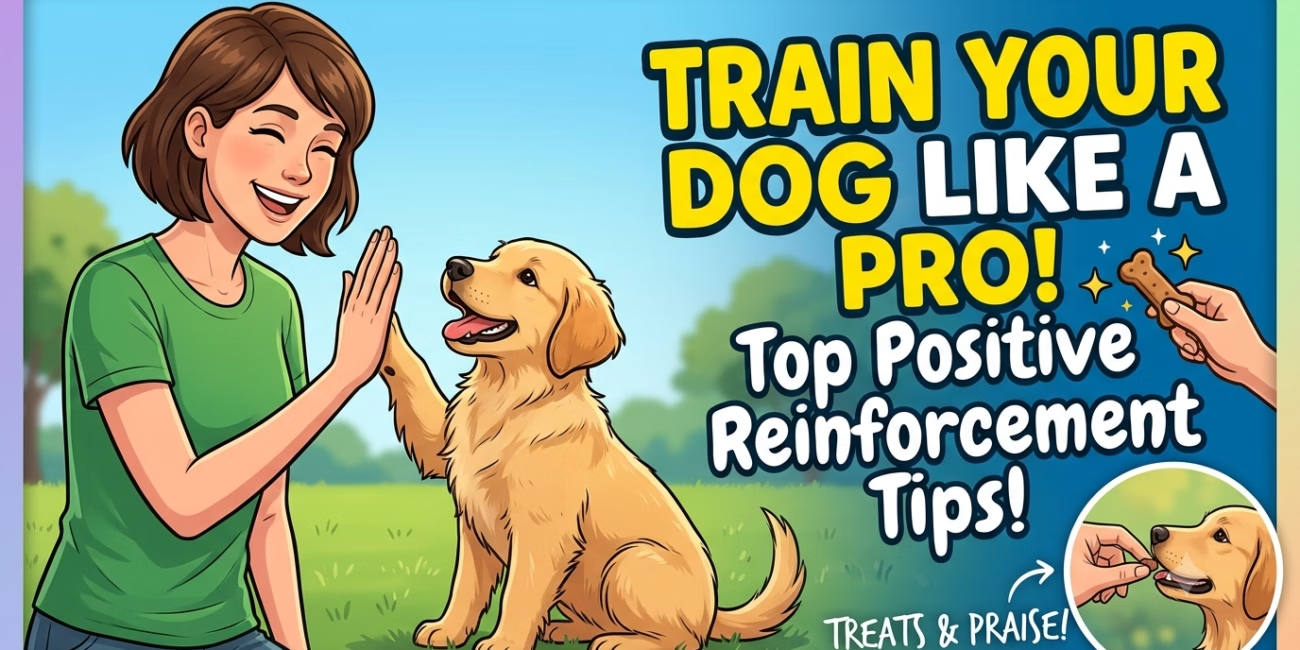
Top Positive Reinforcement Tips for Teaching Your Dog New Tricks
For decades, traditional dog training relied heavily on antiquated "dominance theories" and physical corrections to force behavioral compliance. Thankfully, modern veterinary behaviorists have definitively proven what common sense always suspected: dogs learn faster, retain information longer, and experience far less stress when they are active, enthusiastic participants in the process.
Teaching your dog new tricks—whether a simple "shake hands" or a complex "go fetch my slippers"—isn't just a party trick; it provides vital cognitive enrichment that builds neural pathways and strengthens the human-canine bond. By using positive reinforcement, you gamify the learning experience. Here is the operational protocol to transform your training sessions into clear, highly effective communication loops.
The Reinforcement Mechanics Matrix
Before launching into a trick routine, you must align your training variables. If your timing is off or your reward value is miscalculated, your dog will quickly lapse into frustration or apathy.
| Training Catalyst | The Positive Strategy | The Common Failure Point |
|---|---|---|
| Reward Delivery Timing | Marking the *exact* split-second the desired behavior occurs using a clicker or a sharp verbal "Yes! | Delaying the reward by more than 2 seconds, which accidentally reinforces the wrong secondary behavior (like jumping up or walking away). |
| Motivation Tier | Using highly aromatic, soft, pea-sized treats (freeze-dried liver, roasted chicken) reserved strictly for complex tasks. | Using standard, dry daily kibble that lacks the olfactory drive to keep the dog focused in distracting environments. |
| Session Duration | Keeping sessions limited to ultra-focused micro-bursts of 2 to 5 minutes, ending explicitly on a successful repetition. | Dragging out sessions for 20+ minutes until the dog becomes mentally fatigued, physically tired, or completely checked out. |

4 Actionable Steps for Flawless Trick Training
Do not expect your dog to execute a complex trick perfectly on the first try. Instead, use a behavioral science technique called "shaping"—rewarding successive approximations of the final goal. For example, if you are teaching your dog to "roll over," first reward them for laying down, then for shifting their weight onto one hip, then for exposing their belly, and finally for completing the full rotation. Break the mountain down into small hills.
Using a piece of food right in front of your dog's nose to physically guide their body into a position (luring) is an excellent way to start a new trick like "spin" or "bow." However, if you use the treat in your hand for more than a dozen repetitions, the food becomes a visual crutch. Transition rapidly to an empty hand acting as a distinct hand signal, and reward them from your pocket or pouch *after* they complete the movement.
Some of the most engaging tricks do not need to be lured at all; they just need to be "captured." Keep a clicker or treats nearby during your normal day. If your dog naturally stretches into a deep yoga bow or lets out a funny yawn, instantly mark it with a "Yes!" and a high-value treat, then name it ("Bow!" or "Speak!"). Dogs quickly realize they can trigger rewards by deliberately repeating natural habits.
A dog cannot process cognitive challenges if their sensory environment is overloaded. When introducing a brand-new trick, start in a quiet room with the TV off, no other pets present, and minimal distractions. Once the muscle memory is locked in indoors, gradually add layers of difficulty—moving to the backyard, then to the front porch, and finally to a bustling public park.
The Verdict: Clear Communication Wins the Game
Positive reinforcement trick training is ultimately an exercise in clarity. When you couple precision marker timing with highly appealing rewards and structured, incremental steps, you remove the guesswork for your dog. They will view training not as a chore to endure, but as a thrilling puzzle game they are eager to win.
Want to turn your pet care passion into advanced, practical expertise? Subscribe to the DiggityDog Newsletter today for expert advice delivered straight to your inbox!

J.V. CHARLES – DiggityDog
J.V. Charles is a pet care specialist and dedicated pet advocate. He founded DiggityDog to bridge the gap between complex veterinary science and practical, everyday advice that empowers pet parents to live happier, healthier lives with their furry companions.

Other Articles

10 Dog Training Mistakes To Avoid
Tips for Treating Dog Skin Irritation After Grooming


No Comment! Be the first one.